Bright Coding
Mar 18, 2026
Oppenheimer — minimalist movie poster, constructed from symbols/particles) A minimalist movie poster for Oppenheimer.
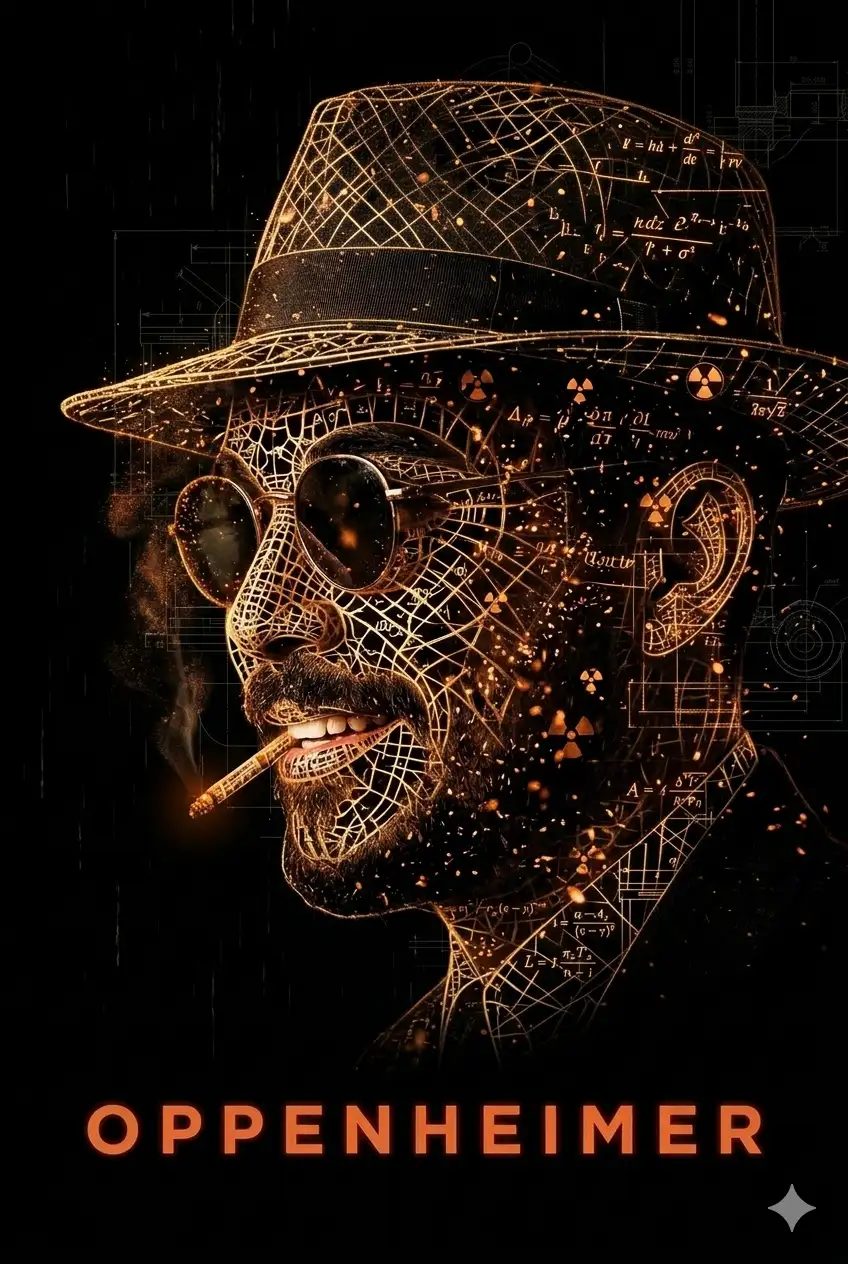
Use the reference image (Oppenheimer — minimalist movie poster, constructed from symbols/particles) A minimalist movie poster for Oppenheimer. The central focus is a dramatic side-profile close-up of reference image as Oppenheimer wearing his iconic dark fedora and round sunglasses, with a faint cigarette glow near the lips. His entire face and hat are meticulously constructed from cascading atomic elements—glowing orange/amber embers, drifting smoke-like particles, and scattered physics equations / radiation symbols / blueprint lines that vary in brightness to define sharp facial contours and the glasses silhouette. Background: void-like deep black, with subtle heat haze and a thin vertical “falling ash” effect (like nuclear dust) that replaces the Matrix-style digital rain, clean and controlled. Typography: at the bottom, the title “OPPENHEIMER” in a bold, condensed, modern cinematic typeface, colored burnt orange with soft glow, perfectly centered, high-end editorial spacing, premium poster grid. Mood: ominous, restrained, catastrophic tension. Cinematic lighting, high contrast, razor-sharp particle detail, high-resolution graphic design, professional theatrical one-sheet layout, print-ready. Negative Prompt (realistic skin texture, photorealistic portrait, colorful neon palette, blue/purple cyberpunk, 3D render, photograph, messy composition, blurry, low resolution, noisy artifacts, white background, multiple people, extra faces, distorted sunglasses, bad hands, incorrect hat shape, cluttered background, ugly typography, misspelled title, random logos, watermark, cheap poster layout, over-saturated reds, cartoon, anime)
Prompt Information
Category
illustration
Created
3 weeks ago
Views
24
ID
#792
More Like This
View Allposter featuring a miniature 3D model of City
Create a stylish 2:3 poster featuring a miniature 3D model of [DUBAI], showcasing its iconic landmarks bursting through a torn, horizontally laid world map. Integrate the city into the map seamlessly with realistic shadows and depth. Add a sleek white 3D text of the city name that blends naturally into the scene. Use dramatic camera perspective, crisp lighting, and a premium travel-poster aesthetic
technical infographic of [HARD DISk] with a 45-degree isometric 3D perspective showing the device slightly tilted to reveal depth and dimension
Create a technical infographic of [HARD DISk] with a 45-degree isometric 3D perspective showing the device slightly tilted to reveal depth and dimension. Combine a realistic photoreal render with black ink technical annotations on pure white background. Include: Key component labels with color-coded callout boxes Internal component visibility through transparent/cutaway sections Measurements, dimensions, and precise scale markers Material callouts and quantities Color-coded arrows for function/flow: RED (power/battery), BLUE (data/connectivity), ORANGE (thermal/processor), GREEN (sensors/haptics) Simple schematics or cross-sectional diagrams where relevant Place “HARD DISk” title in a hand-drawn technical box (top-left corner). Style: Black linework (technical pen/architectural), sketched but precise. Object remains clearly visible. Educational museum-exhibit vibe. Clean composition, balanced negative space. Perspective: Isometric 3D angle—tilted to show depth, dimension, and internal architecture dramatically. Like a professional product teardown or engineering manual. Colors: ~10-15% accent density. Black dominant. White background. aspect ratio 6:9, ultra-crisp, social-feed optimized.
Exploded Anatomy: The Human Body
{ "variables": { "ORGANISM_NAME": "<<<user enters only the organism name>>>" }, "promptDetails": { "description": "Ultra-detailed anatomical exploded view (exploded-view) and layered biological infographic of {ORGANISM_NAME}, presented as an educational, clinical-clear scientific visual.\n\nSpecies-accuracy rule (mandatory): Automatically infer the correct anatomy for {ORGANISM_NAME}. If it is a vertebrate, show an internal skeleton (skull, spine, ribs, limb bones as applicable). If it is an invertebrate, show the appropriate exoskeleton/segments and primary support structures. Automatically choose the correct respiratory organs for {ORGANISM_NAME} (lungs, gills, tracheal system, etc.). Depict the reproductive system in a measured, educational manner (no explicit nudity).\n\nCamera and composition:\n- 3/4 front isometric angle, scientific product/anatomy render perspective.\n- Main body centered; outer body partially transparent and opened.\n- Anatomical layers and major systems are separated and floating around the main body in a clean, symmetric, hierarchical exploded layout.\n- Even spacing between layers; no clutter.\n- Callout leader lines never cross; labels stay inside the frame and remain highly legible.\n\nLayers and systems (outer to inner, species-appropriate):\n1) Outer surface: skin or exoskeleton/outer tissue.\n2) Support system: skeleton or exoskeleton/segments.\n3) Muscular system: major muscle groups and tendon attachments.\n4) Circulatory system: heart and major vessels (avoid messy capillary over-detail).\n5) Respiratory system: species-appropriate organs.\n6) Digestive system: stomach/gizzard (if applicable), intestines, liver and associated organs.\n7) Nervous system: brain or ganglia structures, primary nerve pathways.\n8) Reproductive system: species-appropriate core structures.\n9) Signature anatomy: highlight {ORGANISM_NAME}-specific distinctive structures (wings, fins, tail, horns, pouches, antennae, etc.) as separate emphasized layers.\n\nLabeling (mandatory):\n- Thin white leader lines + numbered labels.\n- Typeface: minimalist sans-serif, high legibility.\n- Label format: \"## Part Name (System)\". Example: \"03 Sternum (Skeletal)\".\n- Use 12–24 labels total; no duplicate numbers.\n\nVisual style and quality:\n- Photorealistic 3D medical/anatomy render + textbook infographic aesthetic.\n- Clinical clarity, high contrast, razor-sharp detail, 8K.\n- Clean composition, strong negative space management, educational focus.\n\nLighting and background:\n- Soft, even studio lighting; controlled reflections.\n- Background: seamless smooth dark gray or dark navy scientific studio backdrop.", "styleTags": [ "Anatomical Exploded View", "Medical/Biological Infographic", "Layered Anatomy", "Photorealistic 3D Anatomy Render", "Educational Scientific Style", "Minimalist Labels", "Dark Studio Background", "Clinical clarity", "Exploded view hierarchy" ] }, "negativePrompt": "blood, gore, horror, surgery scene, open wounds, excessive graphic content, real-person portrait, human-identity face, celebrity likeness, messy exploded layout, unnecessary extra organs/limbs, incorrect anatomy, blurry labels, unreadable text, crossed/overlapping leader lines, cartoon style, low-poly, watermark, logo, broken perspective, excessive noise, heavy motion blur", "generationTips": { "aspectRatio": "2:3", "detailLevel": "ultra", "stylization": "low-medium", "camera": { "angle": "3/4 front isometric", "lens": "scientific product/anatomy render perspective" }, "lighting": "soft, even, medical-illustration clarity", "background": "seamless smooth dark gray or dark navy", "compositionLocks": [ "no crossing leader lines", "labels legible and inside frame", "even spacing and clear hierarchy between layers" ] } }