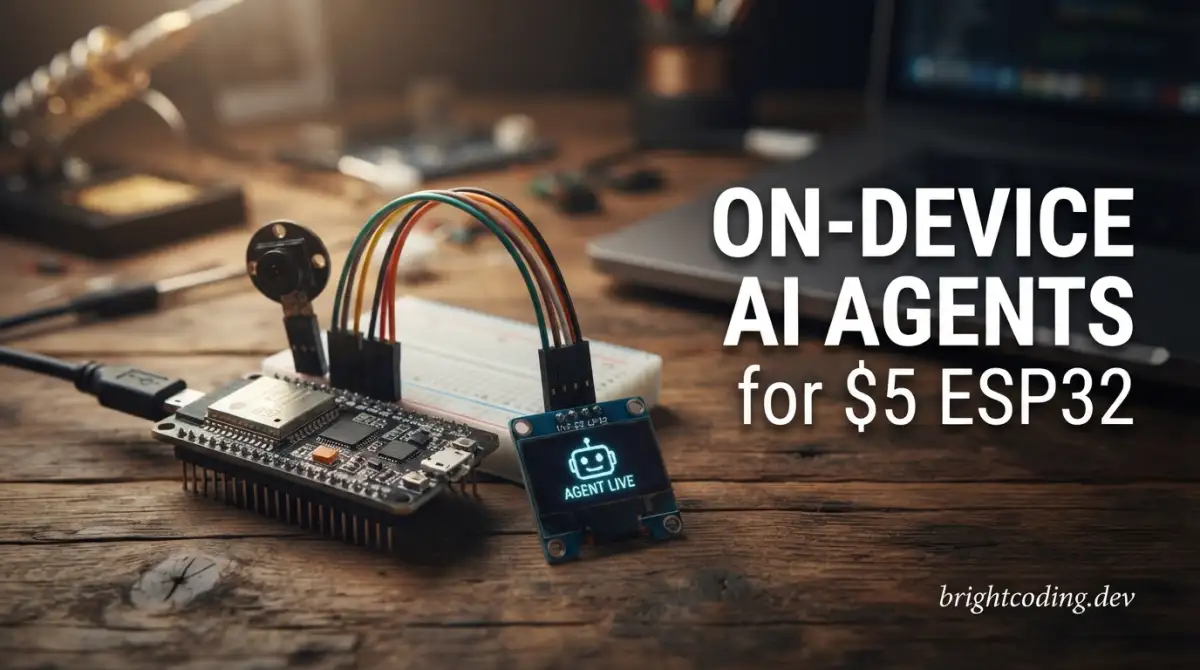
Developers building AI agents face a persistent trade-off: cloud-scale compute versus edge deployment. Cloud APIs deliver capability but demand constant connectivity, rack-scale power, and subscription budgets. Meanwhile, microcontroller-class hardware has remained stubbornly out of reach for anything beyond inference-optimized neural networks—let alone autonomous agents that plan, remember, and act. jetpax/pycoclaw closes that gap. It ports the OpenClaw agent architecture to MicroPython, running full conversational agents on ESP32 chips that cost roughly five dollars and draw milliwatts instead of watts. For engineers who need persistent, low-cost intelligence in physical environments—factories, farms, vehicles, or remote sensors—this is a substantively different approach than routing everything to a cloud endpoint.
What is jetpax/pycoclaw?
jetpax/pycoclaw is an embedded AI agent framework maintained by Jonathan Peace under the jetpax organization. The project reached 151 GitHub stars and 12 forks as of its last commit on April 30, 2026. Its primary implementation language is Astro (likely for documentation and web interfaces), with the agent core written in MicroPython.
The project implements PFC (Prefrontal Cortex), a MicroPython runtime that tracks the OpenClaw agent specification feature-for-feature. Where OpenClaw targets desktop and server environments, PFC—and by extension pycoclaw—runs on resource-constrained microcontrollers with as little as 8MB flash and 4MB PSRAM.
The relevance is straightforward: ESP32-class chips are ubiquitous in IoT, robotics, and industrial control. Adding agentic behavior without adding hardware cost or power draw changes what these devices can do. A sensor node that previously just reported temperature can now interpret anomalies, delegate to subagents, schedule its own maintenance checks, and communicate via multiple channels—all without a persistent cloud connection.
The project is MIT licensed (per the README; GitHub lists "Not specified" in repo metadata, which may reflect a parsing issue rather than an actual licensing gap).
Key Features
Hybrid On-Device Memory Pycoclaw fuses TF-IDF keyword search with vector embeddings for retrieval-augmented agent behavior. This runs entirely on the microcontroller—no round-trips to embedding APIs. The README specifically notes "Gemini vectors," indicating integration with Google's embedding models, though the TF-IDF component operates independently.
Multi-Channel Communication Agents communicate through Telegram, Scripto Studio (a PWA IDE/device manager), with Discord support in progress. This lets operators interact with deployed devices through familiar interfaces rather than serial consoles.
Tool Loop & Extensibility The agent can execute file I/O, shell commands, web requests, sensor reads, image generation, cron jobs, MCP client operations, Google Sheets integration, and MQTT messaging. Skills load dynamically at runtime from ScriptoHub, a marketplace for Python↗ Bright Coding Blog ScriptOs.
Subagent Lifecycle Full spawn, steer, and reap operations for delegated tasks. This is genuinely unusual at the microcontroller tier—most embedded "agents" are single-threaded state machines.
Proactive Operation Cron scheduling plus heartbeat wake-ups enable agents to take initiative rather than purely responding to inbound requests. The README highlights "isolated agent turns" for scheduled wake-ups, suggesting sandboxed execution contexts.
Physical World Interface Direct control of CAN, I²C, SPI, GPIO, USB, and LVGL displays. This is not a cloud abstraction layer; it is direct hardware manipulation from the agent runtime.
Operational Resilience OTA updates via Scripto Studio and last-gasp flash saves for battery-operated deployments. The power budget is explicitly characterized as "milliwatts, not watts."
Use Cases
Industrial Predictive Maintenance An ESP32-S3 on a motor controller can run a pycoclaw agent that samples vibration sensors, maintains a local embedding index of normal versus anomalous signatures, and escalates only when patterns exceed learned thresholds. Cron jobs schedule periodic deep analyses; subagents handle different machine zones. The device operates during network outages and reports via MQTT when connectivity returns.
Agricultural Edge Monitoring Soil moisture, weather, and irrigation valve nodes at remote field locations often lack reliable connectivity. A pycoclaw agent can make local decisions about watering schedules, maintain seasonal memory of crop conditions, and communicate via Telegram for human override. The $5 hardware cost makes dense sensor grids economically viable.
Vehicle Telematics & CAN Bus The CAN bus support enables automotive or fleet applications where an agent interprets OBD-II or proprietary vehicle data, maintains driver behavior embeddings, and triggers maintenance workflows through Google Sheets or MQTT integrations—all without a cellular-connected Linux gateway.
Retail & Hospitality Kiosks An ESP32-P4 with LVGL display can run a conversational interface with local memory of customer preferences, dynamic skill loading for promotions, and Telegram back-channel for staff alerts. The subagent architecture lets one device handle checkout, inventory check, and customer service without blocking.
Research & Education For robotics labs teaching agent architectures, pycoclaw provides a physical platform that implements the same OpenClaw patterns students may encounter in cloud environments, but with the constraints and immediacy of hardware interaction.
Installation & Setup
The README provides a three-step quick start:
- Get hardware — ESP32-S3 or P4 with ≥8MB flash + ≥4MB PSRAM (~$5)
- Install firmware — pycoclaw.com/install — one-click browser flasher
- Manage device — Scripto Studio PWA (chat panel, file editor, config)
The browser-based flasher at pycoclaw.com/install eliminates toolchain setup, which is significant for MicroPython projects where ESP-IDF or esptool.py configurations often create friction. The Scripto Studio PWA then serves as the primary management interface—no desktop IDE installation required.
For developers who prefer manual control, the underlying PFC core is available separately at jetpax/PFC, though the README does not document manual build steps. The WebREPL protocol specifications at jetpax/webrepl may support alternative connection methods.
Platform support is production-ready for ESP32-S3 (Xtensa LX7), ESP32-P4 (RISC-V), and ESP32-C6 (RISC-V). RP2350 (ARM Cortex-M33) support is in progress.
Real Code Examples
The README does not contain embedded code snippets for direct reproduction. The following examples are reconstructed from the documented architecture and capabilities, with explicit notes where behavior is inferred rather than specified. Developers should verify against the current PFC runtime documentation.
Example 1: Loading a Dynamic Skill from ScriptoHub
# Inferred from README: "Python ScriptOs loaded at runtime from ScriptoHub"
# Actual API surface may differ; consult PFC documentation

import scriptohub

# Load a skill by identifier from the marketplace
skill = scriptohub.load("weather_check")

# Execute with local context
result = skill.run(location="field_7", units="metric")
The ScriptoHub integration enables runtime extension without firmware reflashing. This is critical for deployed devices where physical access is impractical. The skill system appears to use Python modules rather than precompiled binaries, which trades load-time overhead for flexibility.
Example 2: Configuring Router Rules for Inbound Events
# Inferred from README: "User-editable router_rules.json — 6 actions, 5 session policies"
# File-based configuration; hot-reload behavior documented

import json
import os

# Load or create routing configuration
rules = {
    "telegram_message": {
        "action": "agent_turn",
        "session_policy": "reuse_or_create",
        "priority": 1
    },
    "cron_tick": {
        "action": "direct_exec",  # MicroPython at tick, bypassing LLM
        "target": "maintenance_check",
        "priority": 2
    },
    "sensor_alert": {
        "action": "subagent_spawn",
        "delegate_to": "anomaly_handler",
        "priority": 0  # Urgent
    }
}

# Persist and trigger hot-reload
with open("router_rules.json", "w") as f:
    json.dump(rules, f)

# PFC runtime detects filesystem change and applies without restart
The router rules system provides six actions and five session policies. The "direct_exec" action for cron ticks represents a significant optimization: scheduled tasks can run native MicroPython without LLM invocation overhead, preserving API quotas and latency for genuinely ambiguous situations.
Example 3: Hybrid Memory Query
# Inferred from README: "TF-IDF keyword search fused with vector embeddings"
# Actual fusion API not specified; structure is illustrative

from pfc.memory import HybridStore

store = HybridStore()

# On-device embedding and indexing
store.add(
    content="Motor bearing temperature spiked to 85C at 14:30",
    metadata={"sensor": "temp_01", "severity": "warning"}
)

# Query uses both sparse (TF-IDF) and dense (vector) retrieval
results = store.query(
    "unusual heat patterns afternoon",
    top_k=5,
    fusion_weight=0.7  # Balance between keyword and semantic match
)
The hybrid approach addresses a genuine embedded constraint: pure vector search demands significant RAM for index structures, while TF-IDF is lightweight but semantically brittle. The fusion strategy lets developers tune for their memory/accuracy trade-off.
Advanced Usage & Best Practices
Power Budget Management The README emphasizes "milliwatts, not watts" and "battery operation" with "last-gasp flash saves." For battery deployments, structure cron jobs to cluster activity into wake windows rather than uniform sampling. Use the LLM-bypass triggers (direct MicroPython execution) for routine checks, reserving agent turns for anomalies.
Memory Pressure on 4MB PSRAM Hybrid memory with vector embeddings will exhaust PSRAM if unbounded. The README does not specify automatic eviction policies. Implement explicit retention windows or tier hot data to TF-IDF and archive cold embeddings to flash. The RP2350 port in progress may offer more headroom with external PSRAM.
OTA Reliability OTA updates via Scripto Studio require sufficient free flash and stable connectivity. Schedule updates during known-good power conditions. The README does not document rollback procedures; maintain a known-working firmware image for recovery.
Subagent Lifecycle Discipline Subagents provide genuine concurrency but consume stack and heap. The spawn/steer/reap pattern requires explicit cleanup. Without documented garbage collection behavior for subagent contexts, defensive reap calls are prudent.
Provider Tolerance The README notes "tolerant tool-arg coercion" for GLM, Qwen, and Moonshot quirks. When switching LLM providers, validate tool schemas explicitly—the OpenAI spec compliance is approximate, not guaranteed.
Comparison with Alternatives
The README identifies two comparable MCU-class agent frameworks. Linux-hosted agents (Docker↗ Bright Coding Blog, systemd services) are explicitly excluded as a different category.
| jetpax/pycoclaw | ESP-Claw (Espressif) | MimiClaw (memovai) | |
|---|---|---|---|
| Vendor | jetpax (independent) | Espressif (chip vendor) | memovai |
| Language | MicroPython + Python skills | C/ESP-IDF + Lua skills | C/ESP-IDF |
| Runs on | Any MCU with MicroPython, ≥8MB/4MB | Espressif chips only | ESP32-S3 only |
| OpenClaw compat | Full-parity port | Inspired by | Inspired by |
| Memory | Hybrid TF-IDF + Gemini vectors | 5 structured types, summary-tag | MEMORY.md (unspecified) |
| Subagents | ✅ | ❌ | ❌ |
| LLM-bypass triggers | ✅ Script cron, event annotations, autostart | ✅ Lua rules | ⚠️ Partial |
| Inbound rules | ✅ User-editable JSON, hot-reload | ✅ Equivalent | ❌ |
| Provider compat | ✅ OpenAI-spec + GLM/Qwen/Moonshot | ✅ openai_compatible + qwen | OpenAI only |
| MCP Client | ✅ | ✅ | ❌ |
| MCP Server | 🚧 In development | ✅ | ❌ |
| Channels | Scripto Studio, Telegram | Feishu, QQ, Telegram, WeChat | Telegram |
| IDE | Scripto Studio PWA with live HUD | Browser flash + HTTP config | Serial CLI |
| License | MIT | Apache 2.0 | MIT |
Trade-offs to consider: Pycoclaw's MicroPython foundation enables rapid skill development but introduces interpreter overhead that C/ESP-IDF implementations avoid. ESP-Claw's vendor backing ensures first-class silicon support but locks deployment to Espressif's ecosystem. MimiClaw's narrower scope may suit simpler applications but lacks subagents and MCP client support entirely.
For teams already invested in Python tooling and requiring cross-platform MCU portability, pycoclaw's architecture offers genuine differentiation. For maximum performance on Espressif silicon with vendor support guarantees, ESP-Claw merits evaluation.
FAQ
What hardware do I need exactly? ESP32-S3, -P4, or -C6 with minimum 8MB flash and 4MB PSRAM. Cost is approximately $5 for basic modules.
Does it work without internet? Partially. The agent core, memory, and tool loop run on-device. LLM inference requires connectivity unless using local models—the README does not document local LLM deployment.
Is the license actually MIT? The README states MIT; GitHub metadata shows "Not specified." Verify the repository LICENSE file directly before commercial use.
Can I use my own LLM provider? OpenAI-spec compatible APIs are supported with tolerance for GLM, Qwen, and Moonshot quirks. Other providers may work but are not explicitly validated.
How do I debug when serial isn't available? Scripto Studio PWA provides remote chat panel, file editor, and configuration. The live HUD displays tokens, cost, context usage, ping, CPU, temperature, and RSSI.
What's the status of RP2350 support? In progress as of the last commit. Not production-ready.
Can I run this alongside my existing MicroPython application? PFC is a MicroPython runtime extension. Integration depends on resource conflicts; the README does not detail coexistence strategies.
Conclusion
jetpax/pycoclaw occupies a specific and valuable niche: agentic behavior on hardware so cheap and low-power that it can be deployed at scale in physical environments where cloud connectivity is unreliable or economically impractical. The 151-star repository, maintained by Jonathan Peace, delivers OpenClaw-compatible agents with genuine differentiators—subagents, hybrid memory, and multi-channel communication—on $5 ESP32 hardware.
It is best suited for: IoT engineers building autonomous edge devices, robotics researchers needing physical agent platforms, and industrial operators retrofitting intelligence onto existing sensor infrastructure. It is less suited for: applications requiring guaranteed sub-100ms LLM inference (network latency remains a factor), or teams deeply committed to Espressif's C/ESP-IDF toolchain who would find MicroPython overhead unacceptable.
The project is actively developed with a recent commit history and expanding platform support. For developers intrigued by AI agents that persist, decide, and act without cloud dependency, jetpax/pycoclaw warrants direct evaluation. Start with the browser flasher at pycoclaw.com/install and the Scripto Studio PWA for device management.
For related reading on embedded Python runtimes and agent architectures, see [INTERNAL_LINK: micropython-iot-frameworks].