
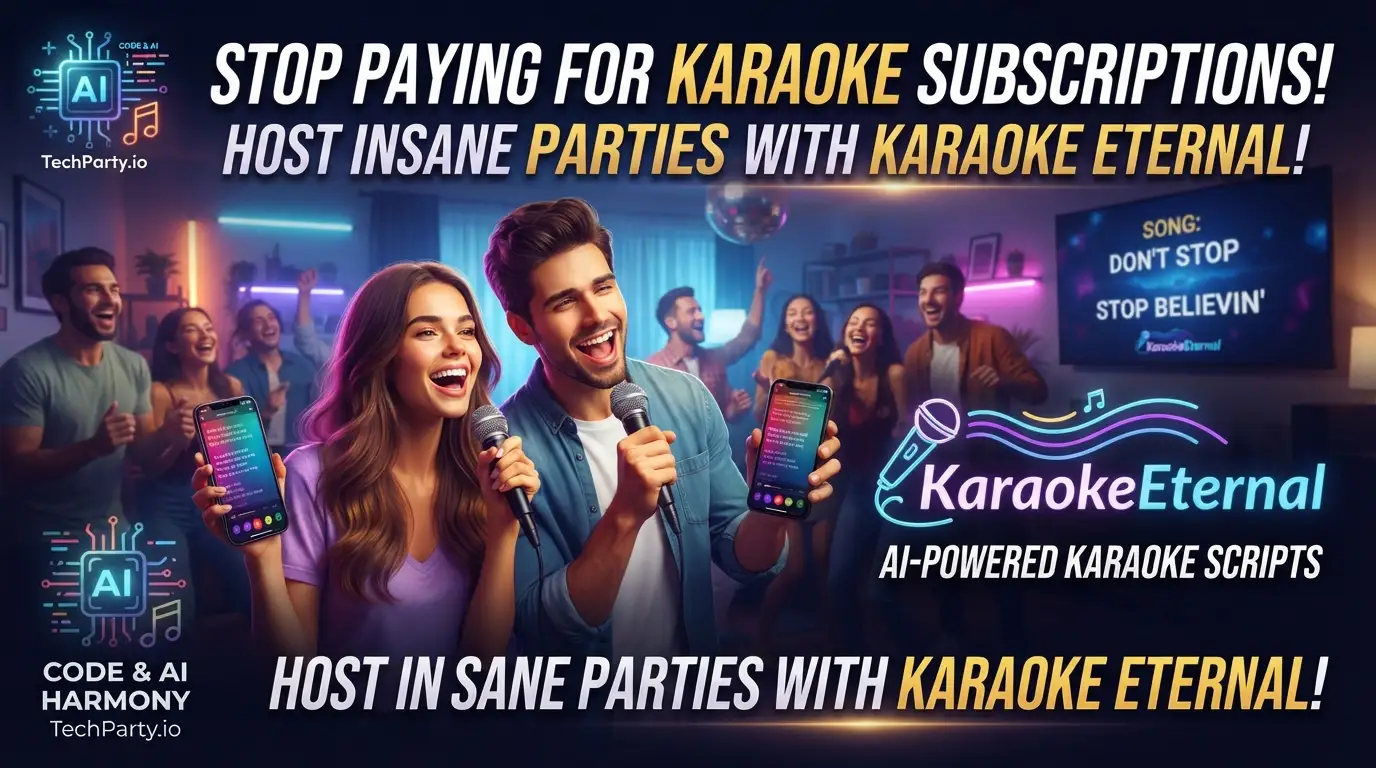
What if your next house party didn't need expensive equipment, sketchy subscription services, or someone chained to a laptop all night?
Picture this: It's Saturday evening. Your friends are arriving, drinks are flowing, and someone inevitably asks, "Should we do karaoke?" Your stomach drops. You remember the last time—scrambling with YouTube playlists, dealing with ads mid-song, someone's phone dying while they're supposed to be "DJ," and that one person who hogs the queue for forty-five minutes. The dream of effortless party karaoke feels permanently out of reach.
But what if I told you there's a secret weapon that top event hosts and tech-savvy party throwers have been quietly deploying? A system that transforms any browser into a full karaoke command center, lets guests queue songs from their phones without installing anything, and runs entirely on your own hardware—no cloud dependencies, no monthly fees, no creepy data collection.
Enter KaraokeEternal, the open-source karaoke party system that's about to revolutionize how you think about home entertainment. This isn't some half-baked project thrown together over a weekend. It's a battle-tested, architecturally elegant solution that handles MP3+G files, MP4 videos, WebGL visualizations, and multi-room party management with the kind of polish you'd expect from a commercial product—except it's completely free and yours forever.
Ready to discover why developers and party hosts are abandoning paid alternatives in droves? Let's dive deep into what makes KaraokeEternal the most exciting self-hosted entertainment project you've never heard of.
What is KaraokeEternal?
KaraokeEternal is an open-source, self-hosted karaoke party system created by bhj and actively maintained by a passionate community. The project lives at github.com/bhj/KaraokeEternal and represents a fundamentally different approach to karaoke software: instead of relying on cloud services, streaming subscriptions, or proprietary hardware, it puts complete control in your hands.
The system's architecture is elegantly simple yet powerful. It consists of three core components working in harmony:
- The Server: A lightweight Node.js application that serves the web interface and manages your media library. Here's the kicker—it runs on virtually anything: that old Windows laptop in your closet, your MacBook, a Raspberry Pi collecting dust, or even a Synology NAS already storing your files.
- The App: A progressive web application optimized for "karaoke conditions"—meaning it works flawlessly even when your guests are tipsy, the lighting is dim, and everyone's competing for WiFi bandwidth.
- The Player: A dedicated fullscreen interface that handles audio/video output, complete with WebGL-powered visualizations that automatically remove lyric backgrounds for that professional karaoke bar aesthetic.
What makes KaraokeEternal genuinely trending in developer circles isn't just its feature set—it's the philosophy behind it. In an era where every entertainment service wants $15/month and your viewing data, this project represents digital sovereignty. Your songs, your server, your rules. The GitHub repository has gained serious traction among self-hosting enthusiasts, privacy advocates, and anyone who's ever screamed at a karaoke subscription service for dropping their favorite track.
The project explicitly rejects the surveillance capitalism model: no ads, no telemetry, no artificial limitations. The only "price" is the effort to set it up—which, as we'll see, is surprisingly minimal.
Key Features That Blow Paid Alternatives Away
Let's dissect what makes KaraokeEternal technically superior to commercial options that charge monthly fees:
Multi-Format Media Support
Unlike locked-down systems that force proprietary formats, KaraokeEternal embraces industry standards:
- MP3+G playback (including zipped archives) — the classic karaoke format combining audio with CDG graphics
- MP4 video support — for modern HD karaoke tracks with full motion backgrounds
- Automatic lyrics background removal — WebGL shaders intelligently process CDG graphics, extracting crisp white lyrics and compositing them over dynamic visualizations
Browser-Native Architecture
No app store approvals, no platform restrictions. The entire system runs in modern browsers using:
- Web Audio API for precise audio synchronization
- WebGL for GPU-accelerated visualizations
- Service Workers for offline-capable progressive web app functionality
Party-Optimized Queue Management
The "dynamic queue" system solves the social problem of karaoke parties:
- Fair rotation prevents queue monopolization
- Multiple simultaneous rooms with optional password protection—perfect for multi-room venues or separating family-friendly from adult content
- QR code instant joining — guests scan, tap, and they're in. No account creation friction.
Hardware Flexibility
The microphone-agnostic design is genuinely brilliant. Since the player outputs only music (not microphone audio), your sound setup scales from "Bluetooth speaker plus SM58" to "full PA system with mixing board." The server doesn't care about your audio chain—it just serves flawless media.
True Self-Hosting
Your media stays on your hardware. Your usage patterns aren't sold to advertisers. Your party isn't interrupted because someone's CDN had an outage.
Real-World Scenarios Where KaraokeEternal Dominates
Scenario 1: The Apartment Party Host
Sarah lives in a studio apartment with questionable WiFi and zero budget for entertainment subscriptions. She installs KaraokeEternal on her existing MacBook, points it at her MP3+G collection, and her Saturday night transforms. Guests queue songs from their phones without downloading anything. The MacBook HDMI's to her TV. Total equipment cost: $0. Subscription cost: $0. Frustration level: $0.
Scenario 2: The Rural Venue Owner
Jake runs a small bar in a town with unreliable internet. Commercial karaoke systems require constant connectivity for licensing verification. KaraokeEternal runs entirely offline after initial setup—his Raspberry Pi 4 serves fifty patrons simultaneously without breaking a sweat. When the town's fiber goes down (again), he's the only entertainment venue still operating.
Scenario 3: The Privacy-Conscious Family
The Martinez family cancelled their streaming services over data privacy concerns. Their Synology NAS already stores family photos and documents—now it also hosts KaraokeEternal. The kids' birthday parties have professional karaoke without any corporation building profiles on their children's musical preferences. The NAS they already owned now does double duty.
Scenario 4: The Developer Event Organizer
Tech meetups need icebreakers that don't feel forced. At a recent hackathon, organizers deployed KaraokeEternal on a DigitalOcean droplet for $5/month. Two hundred developers queued tracks across three themed rooms ("90s Nostalgia," "Guilty Pleasures," "Songs That Shouldn't Exist"). The QR-code joining meant zero onboarding friction for an international crowd with diverse devices.
Step-by-Step Installation & Setup Guide
Getting KaraokeEternal running is straightforward. Here's the complete process:
Prerequisites
You'll need:
- A machine to act as server (Windows, macOS, Linux, Raspberry Pi, or NAS)
- Node.js v24 or later installed
- Your karaoke media files (MP3+G, MP4, or zipped CDG)
Server Installation
The project offers multiple installation methods detailed in the official server documentation, but here's the developer-friendly path:
# Clone the repository
git clone https://github.com/bhj/KaraokeEternal.git
cd KaraokeEternal

# Install dependencies
npm i

# Start development server
npm run dev
After running npm run dev, watch your terminal for the "Web server running at" message with your server URL. That's your access point.
Production Deployment
For actual party hosting, you'll want a stable deployment:
# Build optimized production bundle
npm run build

# Start production server
npm start
Configuration Essentials
-
Media Library Setup: Configure your media directory path in the server settings. KaraokeEternal will scan and index your collection automatically.
-
Room Creation: Access the admin panel to create rooms. Consider password-protecting sensitive content or creating themed spaces.
-
Network Access: Ensure your server is accessible on your local network. For internet-accessible hosting, configure appropriate firewall rules and consider reverse proxy setup with SSL.
-
QR Code Generation: The system auto-generates QR codes for room joining—print these or display them on screens near your performance area.
Client Access
Guests simply:
- Open their phone's camera or browser
- Scan the room's QR code (or enter the URL directly)
- Start browsing and queuing immediately—no account required for basic guest access
REAL Code Examples from the Repository
Let's examine actual implementation patterns from the KaraokeEternal codebase and documentation.
Example 1: Development Server Startup
The README provides this fundamental development workflow:
# Fork and clone the repo
git clone https://github.com/bhj/KaraokeEternal.git
cd KaraokeEternal

# Install all dependencies (production + development)
npm i

# Launch development server with hot reloading
npm run dev
What's happening here? The npm run dev command triggers a development-specific build pipeline. Unlike production builds, this watches your source files for changes and automatically reloads—critical when you're modifying the React↗ Bright Coding Blog-based frontend or Express server logic. The console output revealing "Web server running at" indicates the Express server has bound to your configured port and is serving both the API endpoints and the compiled client application.
Example 2: Project Structure Understanding
While not explicitly code, the three-part architecture described in the README reveals important technical decisions:
KaraokeEternal/
├── server/          # Express.js + Node.js backend
│   ├── media scanning and indexing
│   ├── WebSocket management for real-time queues
│   └── static file serving
├── app/             # React-based PWA frontend
│   ├── song browser with virtual scrolling
│   ├── queue management interface
│   └── room selection/joining flows
└── player/          # Dedicated fullscreen playback component
    ├── WebGL visualization engine
    ├── CDG graphics parser and renderer
    └── MP4 video playback integration
Technical insight: This separation isn't arbitrary. By decoupling the player from the main app, the system enables dedicated "player machines"—perhaps a Raspberry Pi connected to your TV—while the queue management happens on phones. The WebSocket layer ensures queue state synchronizes across all connected clients in real-time without polling overhead.
Example 3: Modern JavaScript↗ Bright Coding Blog Requirements
The explicit Node.js v24+ requirement signals important technical constraints:
# Verify your Node version
node --version
# Must output v24.0.0 or higher

# If outdated, upgrade via nvm (recommended)
nvm install 24
nvm use 24
Why v24 specifically? Node.js 24 introduced native WebSocket improvements, enhanced fetch API stability, and V8 engine optimizations that KaraokeEternal's real-time features depend upon. The media scanning pipeline likely uses modern fs.promises APIs and ReadableStream transformations that weren't performant in earlier versions. This isn't gatekeeping—it's ensuring your party doesn't stutter when twenty people simultaneously browse your library.
Example 4: Build Pipeline Execution
The development workflow implies this production preparation:
# Clean install for reproducible builds
rm -rf node_modules package-lock.json
npm i

# Type checking and bundling
npm run build

# Verify production output
ls -la dist/
# Should contain optimized client bundles and server assets
Production considerations: The build process likely uses Vite or similar modern bundlers, outputting tree-shaken JavaScript with hashed filenames for cache busting. The server then serves these static assets with appropriate Cache-Control headers while API routes remain dynamic.
Advanced Usage & Best Practices
Performance Optimization
- Pre-scan your library before guests arrive. Initial media indexing can be I/O intensive on large collections.
- Use SSD storage for your media if possible—random access patterns for simultaneous users benefit enormously.
- Enable gzip/brotli compression on your reverse proxy for the PWA assets.
Network Resilience
- Deploy on 5GHz WiFi to minimize interference from Bluetooth microphones and other 2.4GHz devices common at parties.
- For large events, consider a dedicated access point connected directly to your server machine.
Queue Psychology
The "dynamic queue" feature isn't just technical—it's behavioral. Enable fair rotation to prevent the "karaoke hog" phenomenon. Create themed rooms strategically: a "chill" room for nervous first-timers and a "main stage" for exhibitionists naturally sorts your crowd without explicit rules.
Backup Strategy
Your media library represents hours of curation. The self-hosted nature means you're responsible for backups. Mirror your karaoke collection with rsync or similar tools.
Visualization Tuning
The WebGL visualizations automatically remove lyric backgrounds, but lighting matters. Position your player display where ambient light doesn't wash out the dynamic backgrounds—dark walls behind screens dramatically improve perceived quality.
Comparison with Alternatives
| Feature | KaraokeEternal | YouTube Karaoke | Karafun | Smule |
|---|---|---|---|---|
| Cost | Free (self-hosted) | Free with ads | $9.99/month | Freemium |
| Ads | None | Frequent interruptions | None (paid) | Yes |
| Privacy | Complete data sovereignty | Google tracks everything | Account required | Social media↗ Bright Coding Blog integration |
| Offline capable | ✅ Fully | ❌ No | Limited caching | ❌ No |
| Custom media | ✅ Any MP3+G/MP4 | ❌ YouTube only | ❌ Their catalog only | ❌ Their catalog only |
| Multi-room support | ✅ Built-in | ❌ No | ❌ No | ❌ No |
| QR code joining | ✅ Instant | ❌ No | ❌ No | ❌ App required |
| Self-hosting | ✅ Core feature | ❌ Impossible | ❌ Impossible | ❌ Impossible |
| Open source | ✅ MIT license | ❌ Proprietary | ❌ Proprietary | ❌ Proprietary |
The verdict: Commercial services offer convenience at the cost of freedom. KaraokeEternal demands initial setup effort but delivers unmatched flexibility, privacy, and long-term cost savings. For anyone hosting more than two parties yearly, the time investment pays dividends.
Frequently Asked Questions
Is KaraokeEternal really free?
Absolutely. The entire project is open-source under permissive licensing. Your only costs are hardware you likely already own and electricity.
Do guests need to install an app?
No. The progressive web app works directly in mobile browsers. iOS Safari, Chrome, Firefox—all supported. The "install" is optional for offline access.
Can I use my existing karaoke collection?
Yes. MP3+G (including zipped), MP4 videos, and standard formats work natively. No conversion or re-purchasing required.
How many simultaneous users can it handle?
The lightweight Node.js server comfortably serves 50+ concurrent users on modest hardware. Raspberry Pi 4 handles typical house parties without strain.
Is my data safe?
Completely. No telemetry, no analytics, no cloud dependencies. Your usage data never leaves your network unless you explicitly configure external access.
What about song lyrics licensing?
KaraokeEternal is software, not content. You're responsible for legally obtaining your media files—same as playing CDs or using any playback software.
Can I contribute to development?
Yes! Join the #dev channel on the Discord server before major contributions. The maintainer actively manages scope to ensure project health.
Conclusion: Your Parties Deserve Better
KaraokeEternal represents something rare in modern software: a complete, polished experience that respects users. No dark patterns pushing subscriptions. No extraction of personal data. No artificial obsolescence forcing upgrades. Just clean, functional code that solves a real problem elegantly.
The technical architecture—separating server, app, and player concerns while leveraging modern web standards—demonstrates thoughtful engineering that scales from intimate gatherings to venue deployments. The WebGL visualization pipeline alone showcases sophistication exceeding many commercial alternatives.
But beyond technical merits, KaraokeEternal embodies a philosophy worth supporting. In an entertainment landscape increasingly dominated by rental models and surveillance, owning your tools matters. The fifteen minutes you spend setting up this system buys you years of unrestricted, private, customizable karaoke experiences.
Ready to transform your next gathering? Head to github.com/bhj/KaraokeEternal, star the repository, and join thousands of hosts who've already discovered that the best karaoke system is the one you control completely. Your future party guests will thank you—usually around 11 PM, microphone in hand, belting out their favorite song with zero interruptions.
Got questions? The Karaoke Eternal Discord community is welcoming and responsive. See you there.