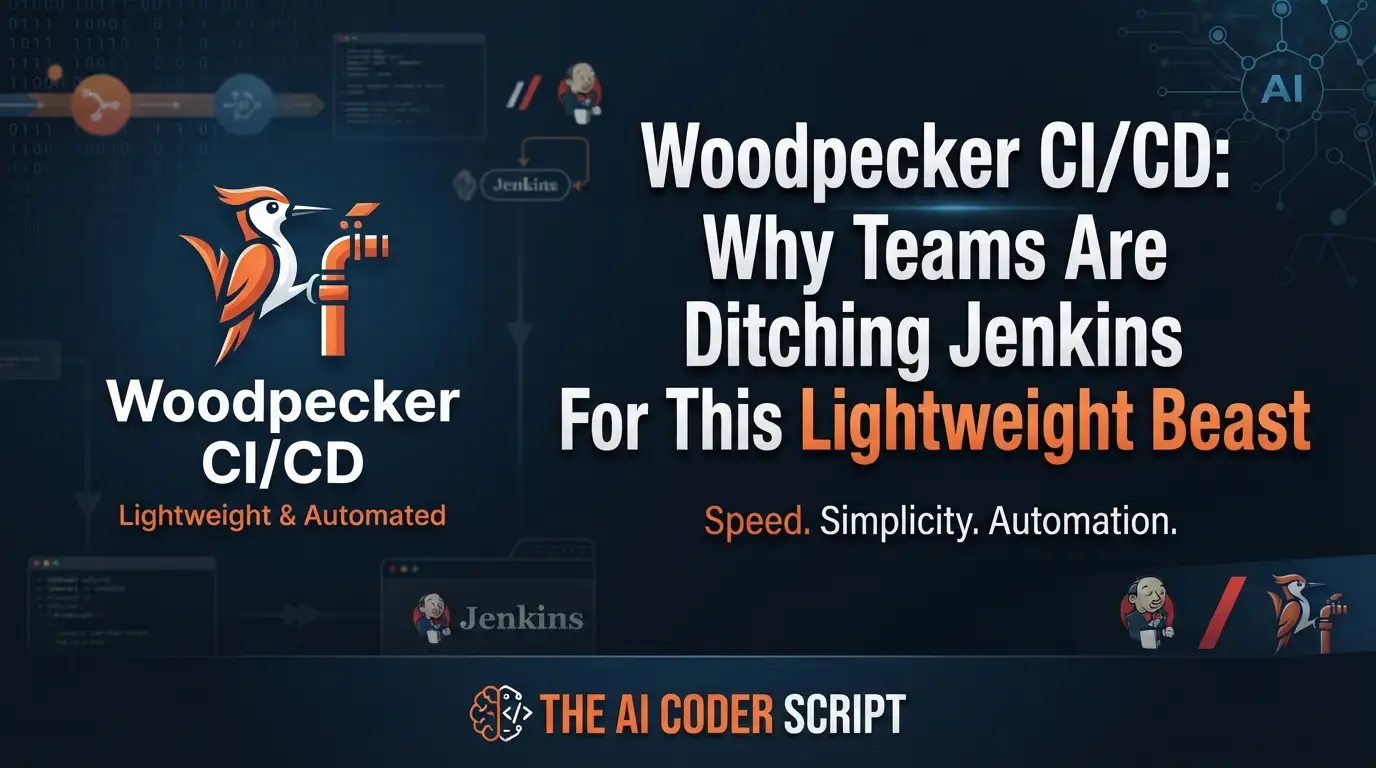
What if your CI/CD pipeline consumed 90% less memory while running faster? Sounds like a fantasy, right? Yet thousands of developers are making the switch right now—and their infrastructure bills are plummeting.
Here's the brutal truth: most CI/CD platforms have become bloated monsters. Jenkins demands gigabytes of RAM. GitHub Actions locks you into proprietary ecosystems. GitLab CI requires a PhD in configuration archaeology. Meanwhile, your builds crawl, your costs spiral, and your team wastes hours debugging YAML spaghetti.
But what if you could deploy a production-ready CI/CD engine in under 5 minutes, using 100 MB RAM for the server and 30 MB for agents? What if it spoke native Docker↗ Bright Coding Blog, integrated with any Git forge, and extended effortlessly through plugins?
Enter Woodpecker—the insurgent CI/CD engine that's rewriting the rules of automation. Born as a community-driven fork of Drone CI, Woodpecker strips away complexity while preserving raw power. Codeberg, the privacy-focused Git hosting platform, bet their entire infrastructure on it. So did thousands of teams tired of vendor lock-in and resource gluttony.
In this deep dive, I'll expose why Woodpecker is becoming the secret weapon of DevOps↗ Bright Coding Blog teams who refuse to compromise. You'll discover its architecture, master real-world configurations, and see exactly why it's displacing legacy tools. By the end, you'll wonder why you didn't migrate sooner.
What Is Woodpecker? The CI/CD Engine Built for the Modern Era
Woodpecker is a simple, yet powerful CI/CD engine with great extensibility—and that description, while accurate, barely scratches the surface.
Origins and Architecture
Woodpecker emerged as a community fork of Drone CI after licensing concerns and governance shifts created uncertainty around the original project. The Woodpecker community prioritized open governance, permissive licensing (Apache 2.0), and sustainable development. This wasn't a hostile fork—it was a survival mechanism for teams who built their infrastructure on Drone's elegant pipeline model.
Written primarily in Go, Woodpecker inherits Drone's architectural DNA: a server-agent model where the server orchestrates builds and agents execute them in isolated Docker containers. But Woodpecker didn't stop at preservation. The project evolved with modern container-native design, native SQLite support (no mandatory database server!), and a plugin ecosystem that rivals proprietary alternatives.
Why It's Trending Now
Three forces are accelerating Woodpecker's adoption:
- Resource efficiency: In an era of cloud cost optimization, Woodpecker's minimal footprint is revolutionary. The server idles at ~100 MB RAM; agents at ~30 MB. Compare that to Jenkins' typical 2-4 GB footprint.
- Forge independence: Unlike GitHub Actions or GitLab CI, Woodpecker integrates with any Git forge—GitHub, GitLab, Gitea, Gogs, Bitbucket, and Forgejo. This matters enormously as organizations diversify their code hosting.
- Configuration simplicity: Woodpecker's YAML syntax is intentionally minimal. No nested job matrices that require documentation to understand. No DSL that compiles to YAML that compiles to JSON. Just clean, declarative pipelines.
The project's OpenSSF best practices badge, active Matrix community, and translation infrastructure via Weblate signal mature governance. When Codeberg adopted Woodpecker as their primary CI/CD engine, it validated production readiness at scale.
Key Features: The Technical Arsenal
Woodpecker's feature set punches far above its weight class. Let's dissect what makes it technically formidable.
Container-Native Execution
Every pipeline step runs in an isolated Docker container. This isn't bolted-on container support—it's foundational. You specify the exact image, environment variables, and commands. No "runner" abstraction leaking host state between builds. Reproducibility is guaranteed because each step starts fresh.
Multi-Forge Integration
Woodpecker's server connects to multiple Git forges simultaneously. Running Gitea internally but mirroring to GitHub? Woodpecker handles both without configuration schizophrenia. The OAuth integration is straightforward, and repository webhooks trigger builds automatically.
SQLite-First, PostgreSQL↗ Bright Coding Blog/MySQL↗ Bright Coding Blog Ready
SQLite as the default database is genius for small-to-medium deployments. Zero database administration, zero network overhead, zero configuration. When you outgrow SQLite, migrate to PostgreSQL or MySQL with a single environment variable change.
Matrix Builds and Multi-Architecture Support
Define build matrices natively in YAML. Test across Go 1.21, 1.22, and 1.23 simultaneously. Build for amd64, arm64, and riscv64 in parallel. Woodpecker's agent pool distributes work intelligently.
Plugin Ecosystem
The plugin directory spans hundreds of integrations: Slack notifications, S3 artifact uploads, Kubernetes deployments, SonarQube analysis. Plugins are Docker images—any container you can build, you can turn into a plugin. This extensibility model is infinitely more accessible than Jenkins' Java plugin architecture.
Secrets and Environment Management
Inject secrets at organization, repository, or pipeline level. Encrypted at rest, exposed only to specified pipeline steps. No more accidentally printing AWS_SECRET_ACCESS_KEY to build logs.
Lightweight Agents
Agents require ~30 MB RAM idle. You can run agents on Raspberry Pi clusters, spare laptops, or burstable cloud instances. The resource profile makes edge CI/CD economically viable.
Use Cases: Where Woodpecker Dominates
1. Self-Hosted Git Infrastructure (Gitea/Codeberg Model)
Organizations running Gitea or Forgejo need CI/CD without surrendering to GitHub's ecosystem. Woodpecker integrates natively, preserving complete data sovereignty. Codeberg's public instance proves this at scale—thousands of repositories, millions of builds.
2. Cost-Conscious Cloud Deployments
Running CI/CD on AWS↗ Bright Coding Blog Fargate or Google Cloud Run? Woodpecker's minimal resource consumption slashes compute costs. A t3.micro instance (1 GB RAM) comfortably runs server + agent. Try that with Jenkins.
3. Multi-Environment Kubernetes Pipelines
Deploy to dev, staging, and production clusters with environment-gated promotions. Woodpecker's plugin architecture integrates with kubectl, Helm, and ArgoCD. The when: conditional syntax enables sophisticated branching logic without external orchestrators.
4. Embedded and IoT Build Farms
Cross-compile for ARM, RISC-V, and MIPS architectures using distributed agents on edge hardware. Woodpecker agents run on Raspberry Pi 4 devices, enabling physical build farms for firmware projects. The 30 MB agent footprint makes this practical.
5. Compliance-Regulated Industries
Air-gapped deployments with no external dependencies. Woodpecker's Docker-based execution means you control every byte in the build environment. Audit trails are comprehensive, and secrets management satisfies SOC 2 requirements.
Step-by-Step Installation & Setup Guide
Ready to deploy? Woodpecker's installation is deliberately minimal. Here's the complete path from zero to running builds.
Prerequisites
- Docker and Docker Compose installed
- A Git forge account (GitHub, GitLab, Gitea, etc.)
- A server with 512 MB RAM minimum (1 GB recommended)
Server Installation via Docker Compose
Create docker-compose.yml:
version: '3'

services:
  woodpecker-server:
    image: woodpeckerci/woodpecker-server:latest
    ports:
      - "8000:8000"
    volumes:
      - woodpecker-server-data:/var/lib/woodpecker/
    environment:
      # Core configuration
      - WOODPECKER_OPEN=true
      - WOODPECKER_HOST=${WOODPECKER_HOST}
      # Forge configuration (GitHub example)
      - WOODPECKER_GITHUB=true
      - WOODPECKER_GITHUB_CLIENT=${GITHUB_CLIENT}
      - WOODPECKER_GITHUB_SECRET=${GITHUB_SECRET}
      # Agent secret for authentication
      - WOODPECKER_AGENT_SECRET=${WOODPECKER_AGENT_SECRET}
      # SQLite is default - zero database config needed!
    restart: always

  woodpecker-agent:
    image: woodpeckerci/woodpecker-agent:latest
    command: agent
    restart: always
    depends_on:
      - woodpecker-server
    volumes:
      - /var/run/docker.sock:/var/run/docker.sock
    environment:
      - WOODPECKER_SERVER=woodpecker-server:9000
      - WOODPECKER_AGENT_SECRET=${WOODPECKER_AGENT_SECRET}

volumes:
  woodpecker-server-data:
Environment Configuration
Create .env file:
# Your public Woodpecker URL
WOODPECKER_HOST=https://ci.yourdomain.com

# GitHub OAuth application credentials
GITHUB_CLIENT=your_github_oauth_client_id
GITHUB_SECRET=your_github_oauth_client_secret

# Generate with: openssl rand -hex 32
WOODPECKER_AGENT_SECRET=generate_a_random_64_character_hex_string_here
Launch and Verify
# Pull and start services
docker compose up -d

# Verify server is healthy
curl http://localhost:8000/healthz

# Check agent connected
docker logs woodpecker-woodpecker-agent-1 | grep "connected"
First-Time Setup
- Navigate to
http://localhost:8000 - Authenticate with your Git forge
- Activate repositories from the web UI
- Add
.woodpecker.ymlto any activated repository
Production hardening: Add TLS termination (nginx/traefik), configure PostgreSQL for scale, and mount agent volumes for Docker layer caching.
REAL Code Examples from the Repository
Woodpecker's power emerges in .woodpecker.yml configurations. These examples demonstrate progressively sophisticated patterns.
Example 1: Basic Pipeline with Multiple Steps
# .woodpecker.yml - Foundational pipeline structure
# Each step runs in an isolated container with explicit dependencies

steps:
  # First step: fetch dependencies
  fetch-deps:
    image: golang:1.22
    commands:
      - go mod download
      - go mod verify

  # Second step: run tests (depends on fetch-deps implicitly via ordering)
  test:
    image: golang:1.22
    commands:
      - go test -race -coverprofile=coverage.out ./...

  # Third step: build binary
  build:
    image: golang:1.22
    commands:
      - CGO_ENABLED=0 go build -ldflags="-w -s" -o app .
    # Artifacts automatically available to subsequent steps
Key insight: Steps execute sequentially by default. Each image: declaration creates a fresh container. The commands list runs in the working directory (repository root). This explicit isolation prevents "works on my machine" failures.
Example 2: Conditional Execution and Matrix Builds
# .woodpecker.yml - Advanced patterns for real-world complexity

steps:
  # Matrix builds: test across multiple Go versions simultaneously
  test-matrix:
    image: golang:${GO_VERSION}
    commands:
      - go test ./...
    # Matrix expansion creates parallel jobs
    matrix:
      GO_VERSION:
        - "1.21"
        - "1.22"
        - "1.23"

  # Conditional deployment: only on main branch with tag
  deploy-production:
    image: alpine/helm:latest
    commands:
      - helm upgrade --install myapp ./chart
    # Powerful conditional logic without external tools
    when:
      - event: push
        branch: main
      - event: tag
    # Secrets injected only to this step
    secrets: [kubeconfig, helm-repo-token]
Critical pattern: The when: clause supports complex boolean logic. This step triggers on either main branch pushes or any tag creation. Secrets are scoped—kubeconfig is inaccessible to the test-matrix step, limiting blast radius of potential compromise.
Example 3: Plugin Integration and Custom Actions
# .woodpecker.yml - Leveraging the plugin ecosystem

steps:
  # Official plugin for Slack notifications
  notify-slack:
    image: woodpeckerci/plugin-slack
    settings:
      webhook: https://hooks.slack.com/services/YOUR/WEBHOOK/URL
      channel: #build-alerts
      # Template uses build metadata variables
      template: |
        {{#success}}✅{{/success}}{{#failure}}❌{{/failure}} Build {{build.number}} of {{repo.name}}
        Commit: {{commit.message}}
        Author: {{commit.author}}
    when:
      - status: [success, failure]  # Always notify, never silently fail

  # Custom plugin: any Docker image becomes a plugin
  deploy-s3:
    image: amazon/aws-cli:latest
    commands:
      - aws s3 sync ./dist s3://my-bucket/releases/${CI_COMMIT_SHA}
    environment:
      # AWS credentials from Woodpecker secrets
      AWS_ACCESS_KEY_ID: ${AWS_KEY}
      AWS_SECRET_ACCESS_KEY: ${AWS_SECRET}
      AWS_DEFAULT_REGION: us-east-1

  # Multi-platform build using BuildKit
  buildx:
    image: woodpeckerci/plugin-docker-buildx
    settings:
      repo: myregistry/app
      tags: latest,${CI_COMMIT_SHA:0:8}
      platforms: linux/amd64,linux/arm64
      # Registry authentication via secrets
      username: ${DOCKER_USERNAME}
      password: ${DOCKER_PASSWORD}
Architectural insight: The woodpeckerci/plugin-slack demonstrates Woodpecker's convention-based plugin system. The container receives settings as environment variables. The Go template engine in template: accesses rich build metadata. Meanwhile, plugin-docker-buildx shows how specialized plugins wrap complex tooling—no manual BuildKit configuration required.
Example 4: Services for Integration Testing
# .woodpecker.yml - Service containers for realistic test environments

steps:
  # Run integration tests against real dependencies
  integration-test:
    image: golang:1.22
    commands:
      - go test -tags=integration ./...
    environment:
      # Service containers accessible by hostname
      DATABASE_URL: postgres://test:test@database:5432/testdb?sslmode=disable
      REDIS_URL: redis://cache:6379

# Service definitions: started before steps, torn down after
services:
  database:
    image: postgres:16-alpine
    environment:
      POSTGRES_USER: test
      POSTGRES_PASSWORD: test
      POSTGRES_DB: testdb
    # Health check ensures service ready before steps execute
    health_check:
      test: ["CMD", "pg_isready", "-U", "test"]
      interval: 5s
      timeout: 3s
      retries: 5

  cache:
    image: redis:7-alpine
Production pattern: Service containers solve the "mock vs. real" dilemma. Your integration tests hit actual PostgreSQL and Redis instances—catching serialization issues, connection pool exhaustion, and query planner regressions that mocks hide. The health_check prevents race conditions where tests start before services accept connections.
Advanced Usage & Best Practices
Pipeline Optimization Strategies
- Layer caching: Mount Docker volumes for
go mod cache,npm ci, orpipcaches. Reduces dependency resolution from minutes to seconds. - Parallel step groups: Use
group:to execute independent steps concurrently. Build frontend and backend in parallel, then join for integration tests. - Conditional step skipping:
when.path: "src/**"skips frontend builds when only documentation changed.
Security Hardening
- Pin image digests: Use
golang:1.22@sha256:...to prevent supply chain attacks via tag mutation. - Read-only root filesystems: Add
read_only: trueto step definitions where possible. - Network policies: Restrict agent container network access using Docker network policies.
Scaling Patterns
- Agent pools: Label agents by capability (
gpu=true,arch=arm64), then target withlabels:in pipeline definitions. - Autoscaling: Deploy agents on Kubernetes with HorizontalPodAutoscaler triggered by queue depth metrics.
- Multi-server federation: Run regional Woodpecker servers with shared PostgreSQL, routing builds to nearest agents.
Comparison with Alternatives: Why Woodpecker Wins
| Dimension | Woodpecker | Jenkins | GitHub Actions | GitLab CI |
|---|---|---|---|---|
| Server RAM (idle) | ~100 MB | 2-4 GB | N/A (SaaS) | 2-4 GB |
| Agent RAM (idle) | ~30 MB | 512 MB-1 GB | N/A (SaaS) | 256 MB |
| Forge lock-in | None | None | GitHub only | GitLab optimal |
| Configuration complexity | Minimal YAML | Groovy/DSL | Moderate YAML | Complex YAML |
| Plugin architecture | Docker containers | Java plugins | Marketplace | Ruby/Go plugins |
| Self-hosted cost | $5-20/month | $50-200/month | N/A | $30-100/month |
| Startup time | < 5 minutes | Hours | Instant | 30 minutes |
| Container-native | Native | Bolt-on | Native | Native |
When to choose Woodpecker:
- You value resource efficiency and cost control
- You need multi-forge flexibility
- You prefer explicit, minimal configuration
- You want true open-source governance (Apache 2.0, community-driven)
When to reconsider:
- Deep investment in Jenkins plugin ecosystem (migration cost)
- Requirement for GitHub-native features (Actions tight integration)
- Need for GitLab's integrated DevOps platform (issue tracking, registry, etc.)
FAQ: Your Burning Questions Answered
Is Woodpecker a drop-in replacement for Drone CI?
Mostly yes. Woodpecker forked from Drone and preserves core YAML syntax. Migration typically involves updating image references and adjusting for Woodpecker-specific features. The migration guide covers edge cases.
Can I run Woodpecker without Docker?
The server and agents are distributed as single Go binaries. However, pipeline execution fundamentally requires containerization for isolation. You'd lose core functionality running steps directly on hosts.
How does Woodpecker handle secrets compared to GitHub Actions?
Woodpecker secrets are scoped to organization, repository, or pipeline level, and can be restricted to specific steps. They're encrypted at rest and never exposed to pull requests from forks by default—addressing a common Actions vulnerability.
What's the maximum scale Woodpecker supports?
Production deployments handle thousands of daily builds with horizontal agent scaling. The SQLite default suits small teams; PostgreSQL backend supports enterprise workloads. Codeberg's public instance demonstrates real-world scale.
Is there a managed/SaaS offering?
Currently no official SaaS. Woodpecker is self-hosted by design, preserving data sovereignty. Community members offer managed instances, and the minimal resource requirements make self-hosting accessible.
How active is development?
Very. Check the commit history—multiple commits weekly, regular releases, active Matrix channel, and responsive issue triage. The Open Collective funding sustains core maintainers.
Can I use Woodpecker with monorepos?
Absolutely. The when.path conditional triggers steps only when specific paths change. Combine with group: for parallel execution across monorepo packages. Advanced users implement custom path-based filtering in pipeline logic.
Conclusion: The CI/CD Revolution Is Here—Don't Get Left Behind
Woodpecker represents something rare in infrastructure tooling: genuine innovation through subtraction. It didn't add complexity to compete—it stripped away bloat, preserved power, and delivered a CI/CD engine that respects your time, your resources, and your freedom.
The evidence is compelling. 100 MB server footprint. 30 MB agents. Native multi-forge support. Docker-native execution. True open governance. When Codeberg—an organization literally built on privacy and software freedom—chose Woodpecker for their entire platform, they made a statement about trust and sustainability.
I've evaluated dozens of CI/CD solutions. Most force compromises: power versus simplicity, features versus cost, convenience versus control. Woodpecker is the exception that proves you needn't choose. It scales from Raspberry Pi homelabs to production Kubernetes clusters without architectural pivots.
Your next step is simple: fork the repository, run docker compose up, and experience builds that start in seconds, not minutes. Compare your current CI/CD bill against Woodpecker's resource profile. Calculate the engineering hours reclaimed from configuration archaeology.
The future of CI/CD isn't heavier. It's not more complex. It's Woodpecker—lean, extensible, and unapologetically efficient.
👉 Star the project, deploy your first pipeline, and join the community at github.com/woodpecker-ci/woodpecker