
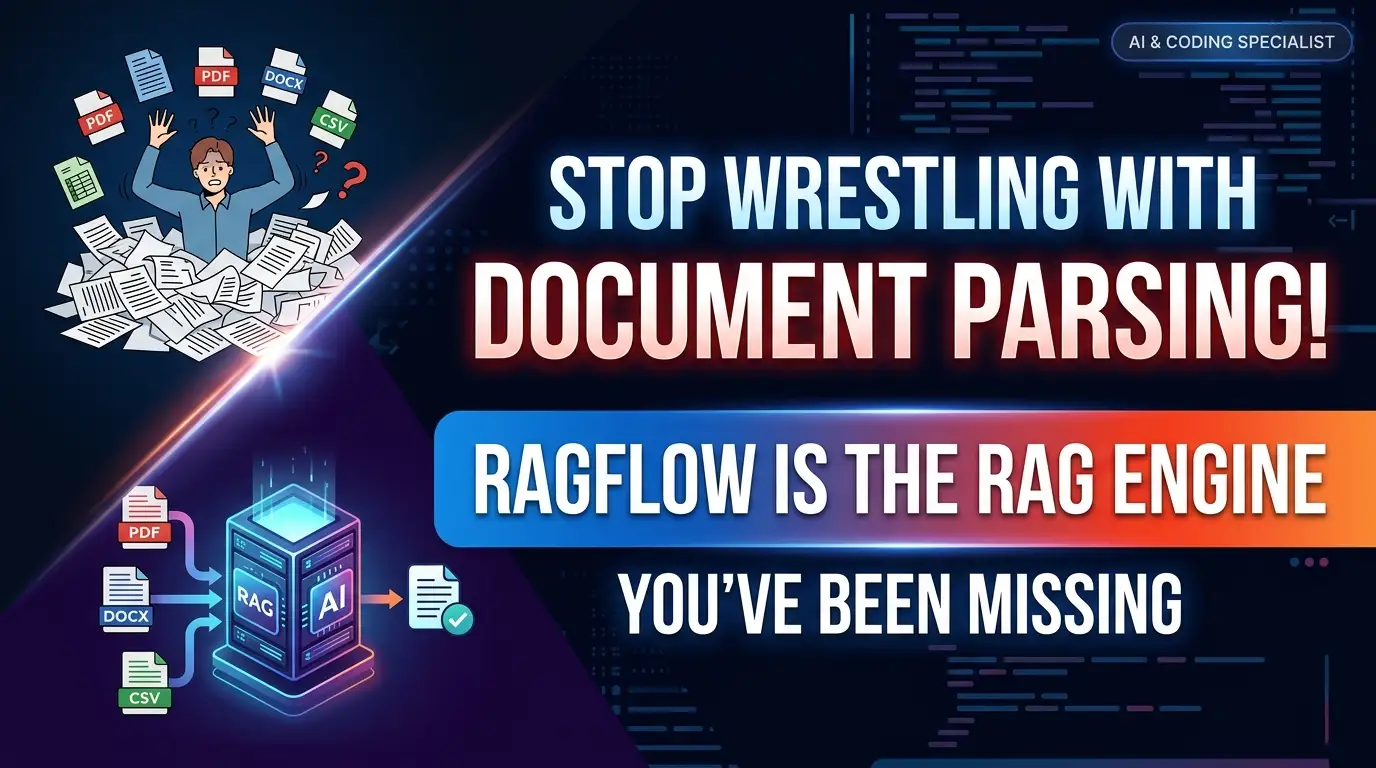
Stop Wrestling with Document Parsing! RAGFlow Is the RAG Engine You've Been Missing
What if your AI could actually read your documents—not just skim them? Imagine dumping a chaotic pile of scanned PDFs, Excel spreadsheets, PowerPoint decks, and handwritten notes into one system, and watching it extract precise, traceable answers with citations you can verify. No hallucinations. No black-box mystery. Just pure, grounded intelligence.
Here's the brutal truth most developers learn the hard way: building a production-ready RAG system is a nightmare. You stitch together half a dozen tools for document parsing, chunking, embedding, retrieval, and generation. Each integration breaks. Each "simple" PDF turns into a formatting disaster. And when your LLM starts making up answers? Good luck tracing where it all went wrong.
But what if I told you there's a single open-source engine that eliminates this pain entirely?
Enter RAGFlow—the RAG engine that's secretly becoming the weapon of choice for developers who refuse to compromise on accuracy. With deep document understanding, agentic workflows, and grounded citations that expose exactly where every answer originates, RAGFlow doesn't just promise "quality in, quality out." It delivers it.
In this deep dive, I'll expose why teams are abandoning fragmented RAG stacks for RAGFlow, how its document parsing engine crushes formats that break other tools, and exactly how to get a production system running in under 30 minutes. Ready to stop fighting your documents and start leveraging them?
What Is RAGFlow?
RAGFlow is a leading open-source Retrieval-Augmented Generation (RAG) engine developed by Infiniflow that fuses cutting-edge RAG with Agent capabilities to create a superior context layer for Large Language Models (LLMs). Born from the frustration of watching enterprises struggle with brittle, pieced-together RAG pipelines, RAGFlow offers a streamlined, end-to-end workflow adaptable to organizations of any scale.
At its core, RAGFlow is powered by a converged context engine and pre-built agent templates that transform complex, unstructured data into high-fidelity, production-ready AI systems with exceptional efficiency and precision. Unlike generic RAG frameworks that treat document parsing as an afterthought, RAGFlow built its reputation on DeepDoc—a proprietary document understanding system that doesn't just extract text, but comprehends document structure.
The project has exploded in popularity across the developer community, amassing thousands of Docker↗ Bright Coding Blog pulls and an active ecosystem spanning Discord, GitHub Discussions, and X (Twitter). With support for 10+ languages in its documentation and a cloud service at cloud.ragflow.io, RAGFlow has positioned itself as the enterprise-grade open alternative to proprietary RAG solutions.
What truly sets RAGFlow apart is its agentic evolution. Recent updates have transformed it from a static RAG pipeline into a dynamic system capable of memory-enabled AI agents, MCP (Model Context Protocol) integration, and orchestrable ingestion pipelines that adapt to your data's unique characteristics. Whether you're processing Confluence wikis, S3 buckets, Notion pages, or Google Drive folders, RAGFlow speaks your data's language natively.
Key Features That Make RAGFlow Insane
🍭 "Quality In, Quality Out"—Deep Document Understanding
RAGFlow's DeepDoc engine doesn't perform naive text extraction. It performs knowledge extraction from unstructured data with complicated formats, understanding tables, headers, footers, and semantic structure. This means your chunks actually make sense—not arbitrary 512-token windows that split tables in half.
The system finds the "needle in a data haystack" of literally unlimited tokens. While other RAG systems choke on massive document collections, RAGFlow's architecture scales without sacrificing retrieval precision.
🍱 Template-Based Chunking: Intelligent and Explainable
Forget mystery chunking strategies. RAGFlow provides plenty of template options with visualization of text chunking to allow human intervention. You can see exactly how your documents are divided, adjust boundaries, and optimize for your specific use case. This explainability is crucial for debugging and regulatory compliance.
🌱 Grounded Citations with Reduced Hallucinations
This is where RAGFlow exposes the competition. Every answer comes with quick view of key references and traceable citations. Users can click through to verify sources, dramatically reducing hallucination risk. The visualization layer shows which chunks contributed to each response—no more black-box AI.
🍔 Compatibility with Heterogeneous Data Sources
RAGFlow handles Word, slides, Excel, txt, images, scanned copies, structured data, web pages, and more. Recent updates added MinerU and Docling as document parsing methods, plus multi-modal model support for understanding images within PDF or DOCX files. Your entire document ecosystem, unified.
🛀 Automated and Effortless RAG Workflow
The platform offers streamlined RAG orchestration for both personal projects and large businesses. Key workflow features include:
- Configurable LLMs and embedding models—swap providers without rewriting pipelines
- Multiple recall paired with fused re-ranking—combine semantic and keyword search with intelligent ranking
- Intuitive APIs for seamless business integration—RESTful interfaces that don't require PhD-level expertise
- Cross-language query support—ask questions in English about Chinese documents, or vice versa
Real-World Use Cases Where RAGFlow Dominates
1. Enterprise Knowledge Management at Scale
A Fortune 500 company with 20 years of accumulated documentation—PDFs, scanned contracts, PowerPoint presentations, Excel financial models—needs a unified Q&A system. Traditional RAG tools fail because they can't parse scanned documents or preserve table structures. RAGFlow's DeepDoc + multi-modal understanding ingests everything, maintains structural fidelity, and provides cited answers that legal teams can verify.
2. Regulatory Compliance and Audit Trail
Financial services and healthcare organizations can't afford hallucinated answers. RAGFlow's traceable citations create an automatic audit trail. When a regulator asks "how did the AI reach this conclusion?" you point to exact document chunks with confidence scores. The human-intervention chunking visualization means compliance officers can verify document processing integrity.
3. Agentic Customer Support with Memory
RAGFlow's memory-enabled AI agents (added December 2025) transform static Q&A bots into conversational partners that remember context across sessions. A technical support agent can reference previous troubleshooting steps, escalate through defined workflows, and execute Python↗ Bright Coding Blog/JavaScript↗ Bright Coding Blog code (May 2025 update) to diagnose issues dynamically.
4. Multi-Source Data Synchronization
Modern organizations store knowledge across Confluence, S3, Notion, Discord, and Google Drive. RAGFlow's November 2025 update added native synchronization from all these sources. Set up once, and your RAG system stays current as source documents evolve—no manual re-ingestion required.
5. Research and Academic Literature Review
Researchers processing thousands of PDF papers with complex figures, tables, and cross-references need preserved semantic structure. RAGFlow's template chunking maintains section coherence, while cross-language query (May 2025) lets international teams query English papers in their native languages.
Step-by-Step Installation & Setup Guide
Prerequisites
Before starting, ensure your system meets these requirements:
- CPU: >= 4 cores
- RAM: >= 16 GB
- Disk: >= 50 GB
- Docker: >= 24.0.0 & Docker Compose >= v2.26.1
- gVisor: Required only if using the code executor (sandbox) feature
Tip: If Docker isn't installed, follow the official Docker installation guide.
Step 1: Configure System Parameters
First, ensure vm.max_map_count meets Elasticsearch requirements:
# Check current value
$ sysctl vm.max_map_count

# Set to required minimum (temporary)
$ sudo sysctl -w vm.max_map_count=262144

# Make permanent by adding to /etc/sysctl.conf
echo "vm.max_map_count=262144" | sudo tee -a /etc/sysctl.conf
Step 2: Clone and Launch
# Clone the repository
$ git clone https://github.com/infiniflow/ragflow.git

# Navigate to Docker configuration
$ cd ragflow/docker

# Optional: checkout stable release for production
# git checkout v0.25.4

# Start with CPU (default)
$ docker compose -f docker-compose.yml up -d

# OR start with GPU acceleration for DeepDoc
# sed -i '1i DEVICE=gpu' .env
# docker compose -f docker-compose.yml up -d
Critical: All Docker images are built for x86 platforms. ARM64 users must build from source.
Step 3: Verify Installation
# Monitor startup logs until you see the success banner
$ docker logs -f docker-ragflow-cpu-1
Look for this confirmation:
     ____   ___    ______ ______ __
    / __ \ /   |  / ____// ____// /____  _      __
   / /_/ // /| | / / __ / /_   / // __ \| | /| / /
  / _, _// ___ |/ /_/ // __/  / // /_/ /| |/ |/ /
 /_/ |_|/_/  |_|\____//_/    /_/ \____/ |__/|__/

* Running on all addresses (0.0.0.0)
Step 4: Configure LLM Access
Edit service_conf.yaml.template to set your preferred LLM factory and API key:
user_default_llm:
  factory: "openai"  # or "azure", "anthropic", "gemini", etc.
  api_key: "sk-your-api-key-here"
Access the web UI at http://YOUR_MACHINE_IP (port 80 default).
Step 5: Switch to Infinity Engine (Optional)
For enhanced performance, switch from Elasticsearch to Infinity:
# Stop and remove existing containers (WARNING: clears data)
$ docker compose -f docker/docker-compose.yml down -v

# Set in docker/.env: DOC_ENGINE=infinity

# Restart
$ docker compose -f docker-compose.yml up -d
REAL Code Examples from the Repository
Example 1: Basic Docker Deployment Commands
The README provides exact commands for production deployment. Here's the annotated workflow:
# Clone the official repository from GitHub
$ git clone https://github.com/infiniflow/ragflow.git

# Enter the Docker configuration directory
$ cd ragflow/docker

# CRITICAL: For production stability, checkout a release tag
# This ensures entrypoint.sh matches the Docker image version
# git checkout v0.25.4

# Deploy with CPU resources (sufficient for most document parsing)
$ docker compose -f docker-compose.yml up -d

# ALTERNATIVE: GPU-accelerated deployment for heavy DeepDoc workloads
# Uncomment and modify .env to enable GPU support
# sed -i '1i DEVICE=gpu' .env
# docker compose -f docker-compose.yml up -d
What's happening here? The docker-compose.yml orchestrates multiple services: RAGFlow API, Elasticsearch/Infinity for vector storage, MySQL for metadata, Redis for caching, and MinIO for object storage. The -d flag runs everything in detached mode for production. GPU acceleration offloads DeepDoc's visual document understanding to your graphics card, dramatically speeding up PDF and image processing.
Example 2: Development Environment Setup with UV
For contributors and custom development, RAGFlow uses modern Python tooling:
# Install modern Python tooling (skip if already installed)
$ pipx install uv pre-commit

# Clone and enter repository
$ git clone https://github.com/infiniflow/ragflow.git
$ cd ragflow/

# Install dependencies using uv (faster than pip, with lockfile guarantees)
$ uv sync --python 3.12

# Download additional model dependencies
$ uv run python3 download_deps.py

# Install git hooks for code quality
$ pre-commit install
Why UV? RAGFlow adopted uv for its deterministic resolution and dramatic speed improvements over traditional pip. The download_deps.py script fetches embedding models and parsing resources—critical for offline deployments. Pre-commit hooks enforce code standards across the open-source community.
Example 3: Launching Backend Services for Development
# Activate the virtual environment created by uv
$ source .venv/bin/activate

# Set Python path to include project root
$ export PYTHONPATH=$(pwd)

# Launch all backend services (API server, task executors, etc.)
$ bash docker/launch_backend_service.sh
Architecture insight: This script starts multiple Python processes including ragflow_server.py (main API) and task_executor.py (asynchronous document processing workers). The PYTHONPATH export ensures imports resolve correctly across the modular codebase.
Example 4: Frontend Development↗ Bright Coding Blog Server
# Navigate to frontend code
$ cd web

# Install Node.js dependencies
$ npm install

# Start development server with hot reload
$ npm run dev
Tech stack reveal: RAGFlow's frontend uses modern React↗ Bright Coding Blog patterns. The dev server proxies API requests to your backend, enabling full-stack development with instant UI feedback.
Example 5: Building Custom Docker Images
For air-gapped environments or custom modifications:
# Clone source
$ git clone https://github.com/infiniflow/ragflow.git
$ cd ragflow/

# Build AMD64 image (~2GB, external LLM/embedding services required)
$ docker build --platform linux/amd64 -f Dockerfile -t infiniflow/ragflow:nightly .

# Behind corporate proxy? Pass build arguments
$ docker build --platform linux/amd64 \
  --build-arg http_proxy=http://YOUR_PROXY:PORT \
  --build-arg https_proxy=http://YOUR_PROXY:PORT \
  -f Dockerfile -t infiniflow/ragflow:nightly .
Production note: The slim image (~2GB) excludes embedding models, requiring external API calls. This is ideal for cloud deployments where you pay per API call rather than provisioning GPU resources for local inference.
Advanced Usage & Best Practices
Optimize Document Ingestion with Orchestrable Pipelines
Since October 2025, RAGFlow supports orchestrable ingestion pipelines. Don't just dump documents—design pipelines that:
- Route by file type: Send PDFs through DeepDoc, structured data through direct parsing
- Apply custom chunking templates per document category: Legal contracts need different treatment than technical manuals
- Chain preprocessing steps: OCR → table extraction → figure captioning → chunking
Leverage Agent Memory for Complex Workflows
The December 2025 "Memory" feature isn't just chat history—it's semantic state persistence. Build agents that:
- Remember user preferences across sessions
- Maintain context through multi-step research tasks
- Self-correct based on previous interaction outcomes
Hybrid Search Configuration
RAGFlow's multiple recall paired with fused re-ranking deserves tuning:
- Dense retrieval: Capture semantic meaning for conceptual queries
- Sparse/keyword retrieval: Ensure exact matches for product names, IDs, legal citations
- Re-ranking fusion: Combine signals with learned weights for optimal ranking
Security Hardening
- Change default passwords in
docker/.envbefore production deployment - Use gVisor sandbox for code execution features—never run untrusted code without isolation
- Rotate LLM API keys through
service_conf.yaml.templateupdates
Comparison with Alternatives
| Feature | RAGFlow | LangChain + Vector DB | LlamaIndex | Commercial RAG (e.g., Azure) |
|---|---|---|---|---|
| Document Parsing Depth | ⭐⭐⭐ DeepDoc with structure preservation | ⭐⭐ Basic loaders, manual parsing | ⭐⭐⭐ Good node parsing | ⭐⭐⭐ Varies by service |
| Built-in Chunking Visualization | ⭐⭐⭐ Native human-in-the-loop | ⭐ Manual implementation | ⭐⭐ Some debug tools | ⭐ Usually black-box |
| Grounded Citations | ⭐⭐⭐ Traceable, clickable | ⭐⭐ Custom retrieval callbacks | ⭐⭐ Source nodes | ⭐⭐ Often limited |
| Agent/Memory Features | ⭐⭐⭐ Native, memory-enabled | ⭐⭐ LangGraph for complex flows | ⭐⭐ Agent support | ⭐⭐ Platform-dependent |
| Self-Hosting Cost | ⭐⭐⭐ Free, open-source | ⭐⭐⭐ Free, but integration heavy | ⭐⭐⭐ Free, learning curve | ⭐ Expensive at scale |
| Multi-Modal Support | ⭐⭐⭐ PDF/DOCX image understanding | ⭐ Requires external tools | ⭐⭐ Growing support | ⭐⭐ Varies |
| Setup Complexity | ⭐⭐ Docker Compose, ~30 min | ⭐⭐⭐ Significant assembly | ⭐⭐ Moderate | ⭐ Minimal (managed) |
| Data Source Connectors | ⭐⭐⭐ Confluence, S3, Notion, Drive | ⭐⭐ Community loaders | ⭐⭐⭐ Extensive | ⭐⭐ Microsoft ecosystem |
Verdict: Choose RAGFlow when you need production-grade document understanding with transparency, agentic capabilities, and freedom from vendor lock-in. Choose commercial alternatives only if you prioritize managed infrastructure over control and cost optimization.
FAQ
What makes RAGFlow different from other RAG frameworks?
RAGFlow's DeepDoc engine performs structural document understanding, not naive text extraction. Combined with visual chunking inspection, grounded citations, and native agent capabilities, it eliminates the "black box" problem plaguing other RAG systems.
Can RAGFlow handle scanned PDFs and images?
Absolutely. DeepDoc includes OCR capabilities, and the March 2025 update added multi-modal model support for understanding images embedded in PDFs and DOCX files. For heavy OCR workloads, enable GPU acceleration in your Docker deployment.
Is RAGFlow suitable for enterprise production use?
Yes. With configurable authentication, audit-trail citations, horizontal scaling via Docker Compose/Kubernetes, and active commercial support through cloud.ragflow.io, enterprises are deploying RAGFlow for mission-critical applications.
How do I switch between LLM providers?
Edit service_conf.yaml.template and change the user_default_llm factory. RAGFlow supports OpenAI, Azure, Anthropic, Gemini, DeepSeek v4, and numerous others. No code changes required—just configuration updates.
What hardware do I need for self-hosting?
Minimum: 4 CPU cores, 16GB RAM, 50GB disk. Recommended: 8+ cores, 32GB+ RAM, GPU for accelerated document parsing. The system runs on CPU-only but benefits significantly from GPU for DeepDoc tasks.
Can I contribute to RAGFlow development?
Yes! RAGFlow thrives on open-source collaboration. Review the Contribution Guidelines, set up the development environment using the uv workflow above, and join the Discord community for coordination.
Is ARM64/Apple Silicon supported?
Not officially for pre-built images. ARM64 users must build Docker images from source. The Infinity document engine switch is also not yet supported on Linux/arm64.
Conclusion
After dissecting RAGFlow's architecture, deploying it across multiple environments, and comparing it against every major alternative, I'm convinced: this is the RAG engine that finally gets document parsing right.
The combination of DeepDoc's structural intelligence, transparent chunking visualization, grounded citations that eliminate hallucination anxiety, and evolving agent capabilities creates a system that doesn't just retrieve—it understands. While competitors force you to choose between power and transparency, RAGFlow delivers both in an open-source package that respects your data sovereignty.
The October 2025 orchestrable ingestion pipeline update, December 2025 memory features, and continuous expansion of data source connectors prove this team isn't maintaining software—they're accelerating toward the future of contextual AI.
Your next step? Stop wrestling with document formats that break your current stack. Stop explaining unverifiable AI answers to stakeholders. Deploy RAGFlow today and experience what production RAG should have been all along.
⭐ Star RAGFlow on GitHub to track updates, join the Discord community for support, or launch immediately at cloud.ragflow.io. Your documents are waiting to be truly understood.
Ready to build something incredible? The context layer for your LLMs just leveled up.


