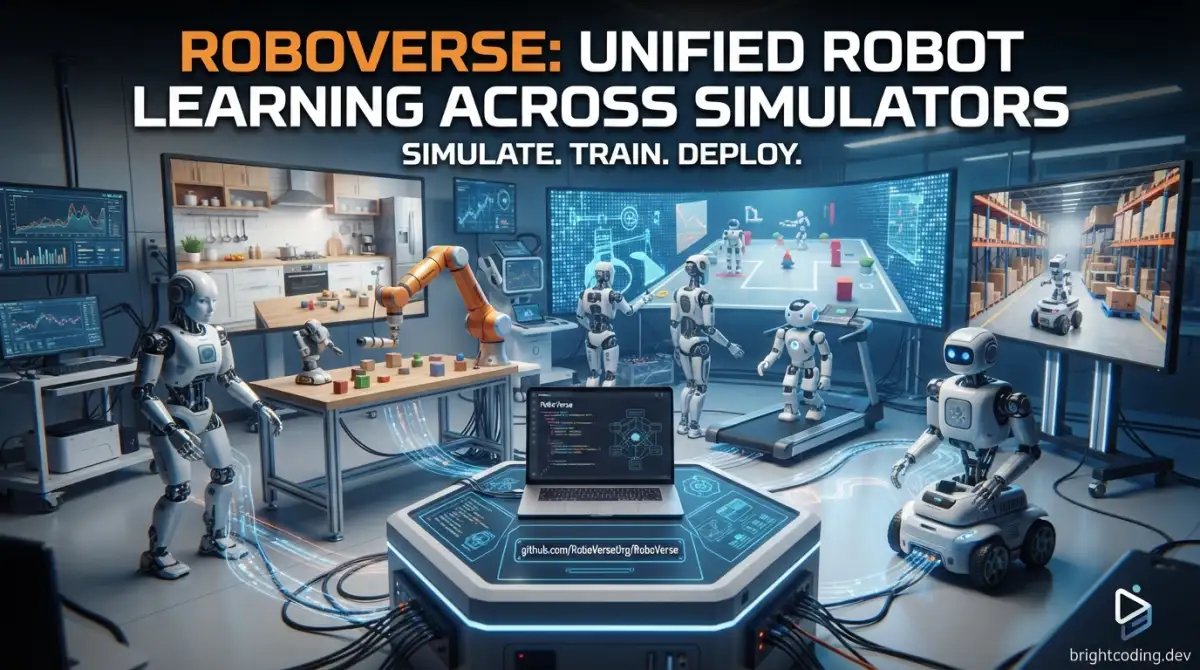
RoboVerseOrg/RoboVerse: Unified Robot Learning Across Simulators
Cross-embodiment robot learning remains one of the most stubborn bottlenecks in robotics research. Training policies that transfer across different robot morphologies—and validating them in diverse simulation environments—typically requires cobbling together incompatible toolchains, rewriting glue code for each simulator, and maintaining fragmented datasets that don't compose. RoboVerseOrg/RoboVerse addresses this fragmentation head-on by providing a unified platform, dataset, and benchmark designed for scalable and generalizable robot learning across multiple simulators.
What is RoboVerseOrg/RoboVerse?
RoboVerseOrg/RoboVerse is an open-source Python↗ Bright Coding Blog project (Apache License 2.0) that provides a unified infrastructure for robot learning research. The repository has accumulated 1,781 stars and 158 forks as of its last commit on July 14, 2026, indicating active community interest in its approach to simulator-agnostic robot learning.
The project was accepted at RSS 2025 (Robotics: Science and Systems), a top-tier robotics conference—an important credibility signal for researchers evaluating whether to build on this platform. The codebase is explicitly described as "actively evolving," with maintainers encouraging contributions through GitHub Issues.
Architecturally, RoboVerse separates concerns cleanly: the core metasim Python package lives in the standalone MetaSim repository, while this repository (RoboVerse) contains tasks, robots, scenes, assets, learning code, and examples. This split allows the simulation abstraction layer to evolve independently from the higher-level learning infrastructure.
The platform integrates nine simulation backends: Isaac Lab/Isaac Sim, Isaac Gym, MuJoCo, SAPIEN, PyBullet, Genesis, cuRobo, PyRep/CoppeliaSim, and Blender. It also incorporates data and tasks from sixteen established robotics projects including RLBench, ManiSkill, LIBERO, Meta-World, robosuite, and others—making it substantially more comprehensive than typical single-simulator frameworks.
Key Features
Multi-Simulator Abstraction. RoboVerse's defining characteristic is its unified interface across simulators with fundamentally different physics engines, rendering pipelines, and robot model formats. Researchers can write task logic once and execute across MuJoCo's fast analytical contact, Isaac Sim's GPU-accelerated dynamics, or Genesis's differentiable simulation—without rewriting environment wrappers.
Cross-Embodiment Task Library. The platform includes tasks, robots, and scenes spanning manipulation, navigation, locomotion, and humanoid control. Data integration from RLBench (task-oriented manipulation), ManiSkill (GPU-parallel sapien environments), LIBERO (lifelong learning), Meta-World (meta-reinforcement learning), and others provides immediate coverage of established benchmarks.
Asset and Scene Ecosystem. Beyond robot models, RoboVerse incorporates scene data from Matterport3D (realistic indoor environments), vMaterials (NVIDIA physically-based materials), and specialized datasets like GAPartNet/GAPartManip for part-level manipulation, UniDoorManip for articulated objects, and GarmentLab for deformable object manipulation.
Benchmarking Infrastructure. As an RSS 2025 accepted project, RoboVerse includes standardized evaluation protocols. The separation of MetaSim (simulation core) from RoboVerse (tasks and learning) enables reproducible benchmarking where simulator-specific performance characteristics can be isolated from algorithmic contributions.
Active Development Model. The maintainers operate transparently through GitHub Discussions with a public wish list for feature requests, prioritized by community upvotes. Discord and WeChat channels provide additional support layers.
Use Cases
Simulator Comparison Research. Robotics researchers studying how policy performance varies across physics engines can use RoboVerse's unified API to control for task definition while varying only the simulator backend. This eliminates the confounding factor of differently-implemented environment logic that plagues cross-simulator studies.
Cross-Embodiment Policy Training. Teams developing policies intended to deploy on multiple robot platforms—say, a Franka arm for manipulation and a humanoid for locomotion—can train and evaluate within a single framework rather than maintaining separate codebases per morphology.
Benchmark Standardization. Competition organizers or research groups seeking to establish reproducible baselines benefit from RoboVerse's integration of established task suites (RLBench, Meta-World, etc.) with standardized simulator interfaces, reducing the "which implementation?" ambiguity that undermines comparability in robotics literature.
Curriculum Learning Across Simulators. Training policies first in fast, approximate simulators (MuJoCo, PyBullet) before fine-tuning in high-fidelity renderers (Isaac Sim, Blender) becomes tractable when environment logic is simulator-agnostic—RoboVerse's explicit design target.
Deformable and Articulated Object Manipulation. The integrated GarmentLab (cloth), UniDoorManip (articulated), and GAPartNet (part-level) datasets enable research on manipulation primitives beyond rigid-body grasping, directly supported by compatible simulator backends.
Installation & Setup
RoboVerse installs as the roboverse-py package, with the metasim dependency resolved from its separate repository. The basic installation targets MuJoCo as the default simulator backend.
Clone and install the base package:
git clone https://github.com/RoboVerseOrg/RoboVerse.git
cd RoboVerse
python -m pip install -e ".[mujoco]"
For development work—including running tests, building documentation, or contributing patches—install with additional development dependencies:
python -m pip install -e ".[dev,mujoco]"
The -e flag installs in editable mode, essential when modifying source code. The [mujoco] extra installs MuJoCo-specific dependencies; other simulator backends require their own extras as documented at roboverse.wiki/metasim/.
Important: The README explicitly directs users to the documentation for "simulator-specific installation details." Isaac Sim/Isaac Lab in particular require NVIDIA GPU drivers, CUDA, and often containerized deployment—these are not handled by pip alone. Plan for additional setup time if your research requires GPU-accelerated simulation.
The project provides tutorials starting with static scene loading, progressing through more complex interactions.
Real Code Examples
The README provides two installation commands as its primary code content. Below are these commands with explanatory context, followed by guidance on how the underlying API would typically be used based on the architectural description provided.
Basic installation with MuJoCo support:
# Clone the repository
git clone https://github.com/RoboVerseOrg/RoboVerse.git
# Enter the project directory
cd RoboVerse
# Install in editable mode with MuJoCo dependencies
python -m pip install -e ".[mujoco]"
This command sequence: (1) retrieves the source, (2) positions in the package root where pyproject.toml or setup.py resides, and (3) triggers a development install with the MuJoCo extra dependency group. The quotes around ".[mujoco]" prevent shell interpretation of the square brackets.
Development installation:
# Install with both development tools and MuJoCo
python -m pip install -e ".[dev,mujoco]"
The dev extra typically includes linters, type checkers, test runners, and documentation build tools—necessary for contributors but not end users.
The README does not contain additional executable code examples beyond installation. Users are directed to the documentation and tutorials for usage patterns. This reflects the project's current documentation state rather than a limitation of the platform itself.
Advanced Usage & Best Practices
Simulator Selection Strategy. Choose simulators based on your research phase, not fidelity alone. MuJoCo offers fastest iteration for policy development; Isaac Sim/Isaac Lab provide photorealistic rendering and GPU batching for final evaluation; Genesis enables differentiable physics for gradient-based optimization. RoboVerse's abstraction makes switching between these backends a configuration change rather than a rewrite.
Dependency Isolation. Given the heavy and sometimes conflicting dependencies across simulation backends (NVIDIA CUDA versions, specific PyTorch builds, physics engine binaries), use separate virtual environments or containers per simulator target. The unified API means your task code remains identical even when environments differ.
MetaSim Version Pinning. Since metasim is developed in a separate repository with its own release cycle, pin to specific commits or tags in production experiments to prevent API drift. The editable install (-e) is appropriate for development but consider frozen requirements for published results.
Community Contribution Pathway. The maintainers encourage contributions through the structured CONTRIBUTING.md and use GitHub Discussions for feature prioritization. Upvoting wish list items is a concrete way to influence roadmap direction—this is not performative openness but a documented decision mechanism.
Comparison with Alternatives
| Platform | Simulator Scope | Primary Focus | License | Best For |
|---|---|---|---|---|
| RoboVerseOrg/RoboVerse | 9+ simulators unified | Cross-embodiment, cross-simulator learning | Apache 2.0 | Research requiring simulator flexibility |
| Isaac Lab (NVIDIA) | Isaac Sim only | GPU-accelerated robot learning | BSD-3-Clause | NVIDIA ecosystem, large-scale parallel training |
| ManiSkill (SAPIEN) | SAPIEN only | GPU-parallel manipulation | MIT | Fast manipulation benchmark iteration |
| robosuite | MuJoCo only | Modular robot learning | MIT | MuJoCo-native research, simpler setup |
RoboVerse's explicit trade-off is complexity for flexibility. Single-simulator frameworks offer simpler dependency management and more mature documentation; RoboVerse provides coverage no single simulator can match. For teams already committed to one backend (e.g., full NVIDIA stack), Isaac Lab may be more ergonomic. For researchers whose questions specifically require cross-simulator validation, RoboVerse is currently the most comprehensive open option.
FAQ
What Python versions are supported?
The README does not specify; check pyproject.toml after cloning or consult the documentation.
Can I use RoboVerse without a GPU? MuJoCo and PyBullet backends run on CPU; Isaac Sim, Isaac Lab, and cuRobo require NVIDIA GPUs.
Is commercial use permitted? Yes, Apache License 2.0 allows commercial use with attribution.
How do I request a new simulator or task? Add to the Wish List category in GitHub Discussions; upvotes influence prioritization.
What's the relationship between RoboVerse and MetaSim? MetaSim is the core simulation abstraction package; RoboVerse provides tasks, assets, and learning code built on top.
Is the project production-ready? The maintainers describe it as "actively evolving"—suitable for research, with API stability not guaranteed.
Where are asset licenses documented? The README states licenses "will be added soon"; contact the maintainers for immediate questions.
Conclusion
RoboVerseOrg/RoboVerse occupies a distinctive position in the robot learning ecosystem: it is the most ambitious attempt to date at unifying multiple simulation backends under a single task and learning framework. The 1,781 stars and RSS 2025 acceptance validate its relevance, while the active development model and community contribution pathways suggest sustained evolution.
This platform is best suited for researchers whose work inherently requires cross-simulator or cross-embodiment validation—particularly those in benchmark development, sim-to-real transfer, or fundamental questions about physics engine impact on policy learning. Teams seeking a single, stable, well-documented simulator backend may find simpler alternatives more productive in the short term.
The codebase is available now at https://github.com/RoboVerseOrg/RoboVerse. Start with the MuJoCo installation path, explore the static scene tutorial, and consider where your research questions benefit from simulator flexibility rather than simulator specificity.
For related reading on robot learning infrastructure, see [INTERNAL_LINK: robot-simulation-frameworks-comparison].